We speak,
through our noodles.
Water, salt, flour. The simpler the ingredients, the stricter the principles.
Even our numbers follow a principle.
Three numbers define Udon Kinoya. Each one has a reason.
Figures based on head-office data; the blending and aging process is continuously managed and improved.
A story that started
with one bowl.
Udon Kinoya began with the simple goal of making one great bowl of udon. Many recipes for delicious udon already exist, but reproducing it every single day at the same quality was an entirely different problem.
Instead of expanding the menu, Udon Kinoya chose to solve this problem through an obsessive focus on the noodle itself.
Great udon
always starts with the noodle.
Udon Kinoya operates its own noodle-making factory. The head office kneads, ages, and packs 48-hour aged noodles every day and supplies them to every store — stores only need to boil and plate with a verified process.
We reproduce handmade-quality noodles in a one-pack format of roughly 80cm, letting stores run a fast, simple, high-turnover kitchen.
An obsession with taste
translated into real numbers.
our Guri flagship recorded a peak day of ₩3,000,000+ in sales.
Udon Kinoya's Guri flagship store achieved this result through simplified ingredient prep and a noticeably faster table turnover.
Head-office data · Guri flagship caseThe figure above is a specific-period result from the Guri flagship store, not an average across all locations. Measurement period, POS aggregation basis, and VAT treatment will be explained with the latest data during consultation.
Craftsmanship in taste.
Simplicity in operation.
Special for the customer. Simple for the owner.
The head office handles
- Noodle-making
- Aging
- Packing
- Standardized broth & key ingredients
The store handles
- Boil
- Pour
- Plate
Actual cooking steps may vary slightly by menu item and store conditions.
A high table turnover
is no accident.
Tablet ordering reduces floor-staff workload, while a counter-style layout and a kitchen-centered flow streamline everything from order to serving.
The scope of these operational efficiencies can vary by store layout and floor size.
Not the most common franchise —
the one built for a real return.
Small-format store (~10 pyeong)
A small-store model designed around a counter layout and simplified flow, aimed at reducing initial investment.
Standard store (~30 pyeong)
A standard-format store where investment scale varies with new construction needs and existing site condition.
Business conversion
A conversion model that reuses an existing restaurant's facilities to reduce investment cost.
You focus
on running the business.
The head-office system takes care of the rest.
running your store.
location analysis for longevity.
to secure your business rights.
ahead of trends.
maximize sales.
Details and availability of support programs will be explained with the latest information during consultation. See head-office support →
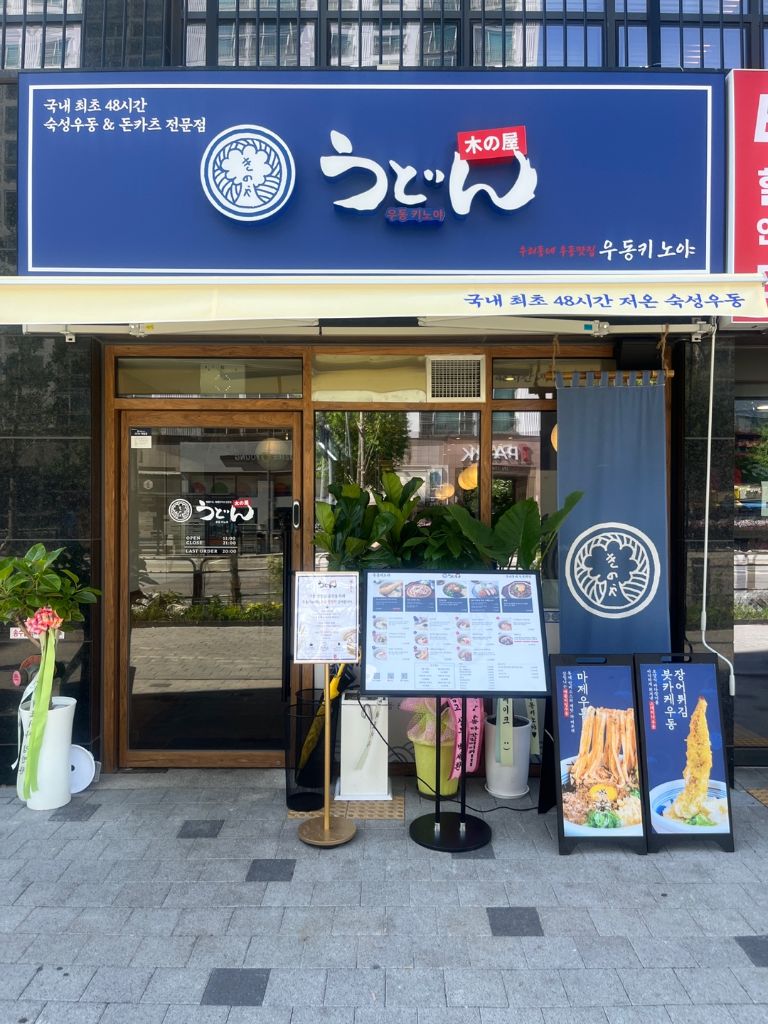
Udon Kinoya is actually open for business
The Korean store directory lists 51 locations across Korea (Seoul 26 · Gyeonggi 17 · Incheon 1 · Chungcheong 2 · Daegu 1 · Busan 3 · Jeju 1). Please confirm hours with the store before visiting.
A system is,
ultimately, built by people.
Udon Kinoya's standardized system is built together by head-office teams covering noodle-making, site development, supervising, and quality management.